

Shantakaram Bhujagashayanam (Vishnu Dhyan Mantra)
शान्ताकारं भुजगशयनं
Shantakaram Bhujagashayanam Padmanabham Suresham: the dhyana shloka of Lord Vishnu reclining on Shesha, with its full meaning.
Shantakaram Bhujagashayanam (Vishnu Dhyan Mantra) · शान्ताकारं भुजगशयनं
Language Sanskrit1 verse
शान्ताकारं भुजगशयनं पद्मनाभं सुरेशं विश्वाधारं गगनसदृशं मेघवर्णं शुभाङ्गम्। लक्ष्मीकान्तं कमलनयनं योगिभिर्ध्यानगम्यं वन्दे विष्णुं भवभयहरं सर्वलोकैकनाथम्॥
Shantakaram bhujaga-shayanam padmanabham suresham, Vishvadharam gagana-sadrisham megha-varnam shubhangam, Lakshmi-kantam kamala-nayanam yogibhir dhyana-gamyam, Vande Vishnum bhava-bhaya-haram sarva-lokaika-natham.
I bow to Vishnu: whose form is peace, who reclines on the serpent, from whose navel the lotus springs, lord of the gods, support of the universe, vast as the sky, dark as a rain cloud, of auspicious form; beloved of Lakshmi, lotus-eyed, reached by yogis in meditation; who takes away the fear of worldly existence, the one Lord of all the worlds.
Shantakaram Bhujagashayanam (Vishnu Dhyan Mantra): audio & video
© T-Series Bhakti Sagar, embedded from YouTube under its standard licence.
How to chant the Shantakaram Bhujagashayanam (Vishnu Dhyan Mantra)
Once or three times.
Before a Vishnu or Satyanarayan puja, before the Vishnu Sahasranama, and on Ekadashi.
- Picture the reclining Lord as each phrase describes him while you recite.
About the Shantakaram Bhujagashayanam
This is the most loved meditation verse (dhyana shloka) on Vishnu, recited before the Vishnu Sahasranama, on Ekadashi and at the start of a Vishnu puja. It paints the Lord whose form is peace, reclining on the serpent Shesha on the cosmic ocean, dark as a rain cloud, lotus-eyed, beloved of Lakshmi, the one who removes the fear of samsara.
Where it is sung
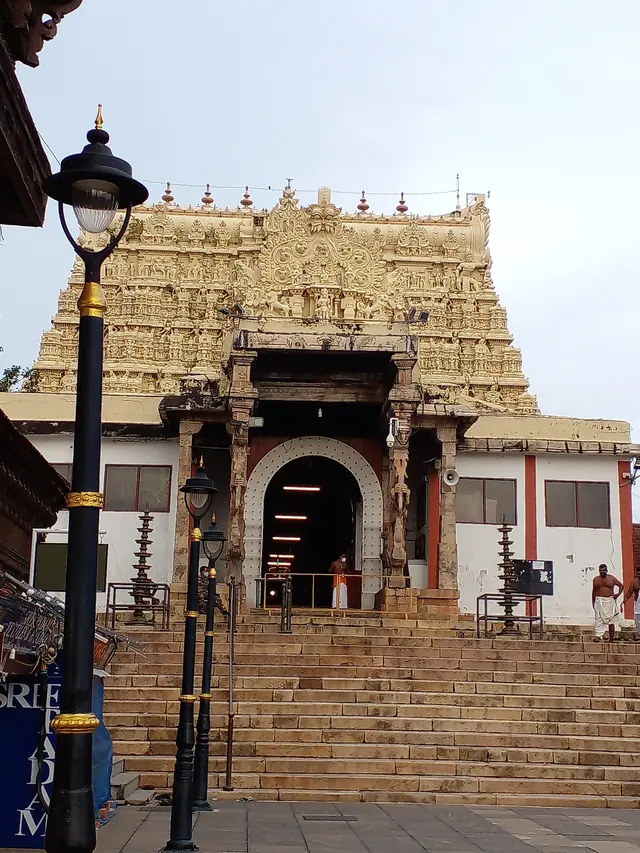 Sree Padmanabhaswamy Temple
Questions
When is Shantakaram recited?
At the start of a Vishnu puja or Satyanarayan katha, before reading the Vishnu Sahasranama, and every Ekadashi.
Have a question about this shloka?
More for Vishnu
- ॐ जय जगदीश हरेOm Jai Jagdish Hare Aarti▶ Video
- मंगलम् भगवान विष्णुःMangalam Bhagwan Vishnu▶ VideoSanskrit
- ॐ नमो भगवते वासुदेवायOm Namo Bhagavate Vasudevaya▶ Video📿 Jap counterSanskrit
- जय लक्ष्मी रमणा — श्री सत्यनारायण आरतीJai Lakshmi Ramana (Shri Satyanarayan Aarti)▶ Video
- ॐ जय एकादशी माताOm Jai Ekadashi Mata (Ekadashi Aarti)▶ Video
- श्रीहरिस्तोत्रम्Shri Hari Stotram (Jagajjala Palam) with Meaning▶ VideoSanskrit
Browse all mantras in the Mantra library, or the whole Aarti, Bhajan & Mantra collection.